 MoneyMouth Club
The "Enshittification" Era: 10 Beloved Brands Ruined by Private Equity
MoneyMouth Team · April 25, 2026 · 4 min read
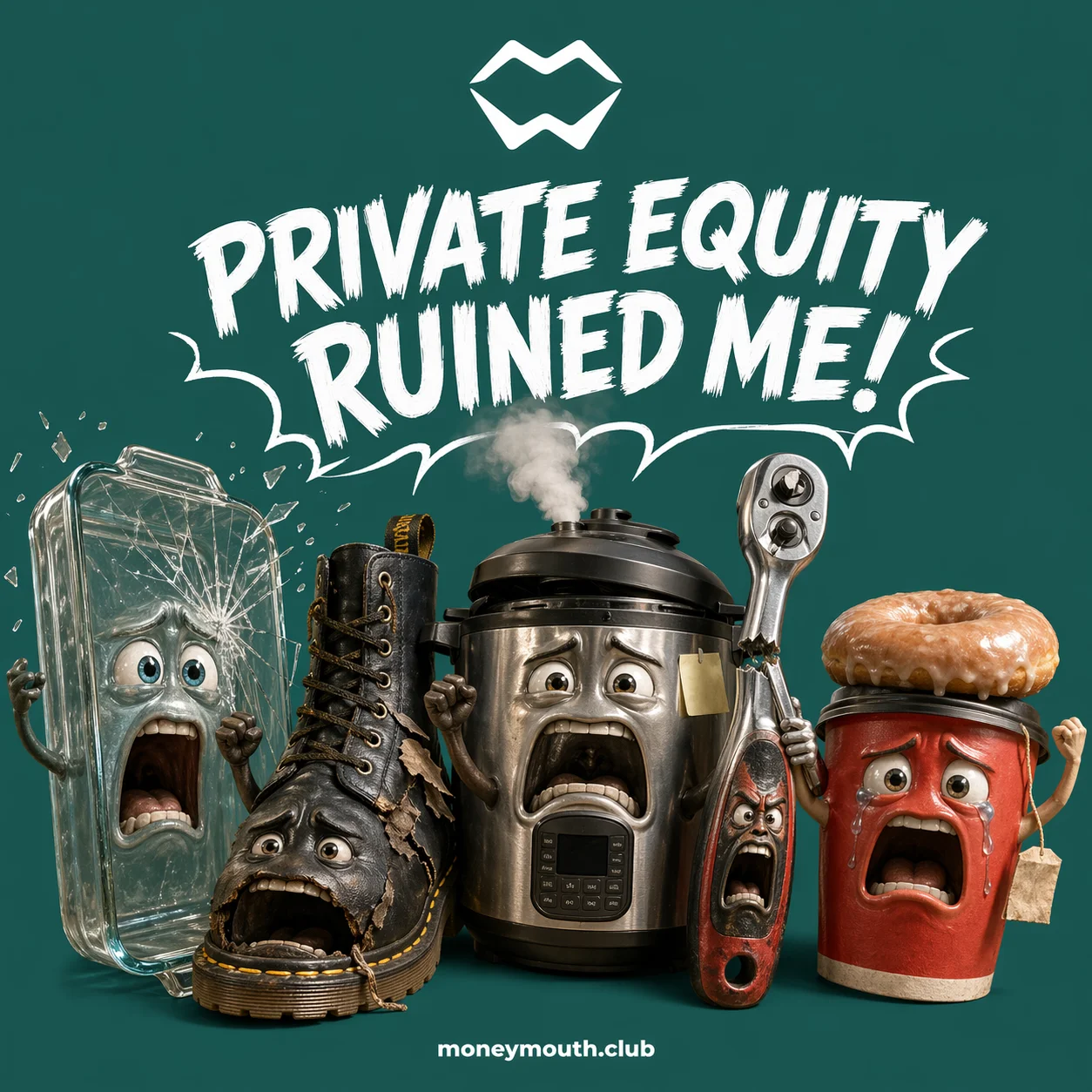
You buy a pair of boots because your last pair lasted ten years.
Six months later, the soles split. You bake a casserole in a brand-new glass dish, and it shatters into a thousand pieces in the oven.
This isn't a coincidence: stuff actually is getting worse, on purpose.
Cory Doctorow originally coined the term "enshittification" to describe the decay of the internet, but it applies just as well to the physical things we buy. And there is usually one specific culprit behind the sudden drop in quality: private equity.
The playbook is brutal and predictable.
An investment firm buys a brand you trust. They quietly swap in cheaper materials and gut what makes it great. They coast on the brand's good name to keep prices high, then cash out before the general public catches on that the quality changed.
Here at MoneyMouth, we think you should know what you're actually paying for. Here are ten beloved brands that got stripped for parts once they got acquired by private equity.
1. Pyrex Vintage Pyrex was a kitchen tank. It was made of borosilicate glass, which meant you could pull it out of a 400-degree oven and slap it on a cold granite counter without a second thought. Then World Kitchen (backed by the PE firm KKR) took over in 1998. They quietly swapped the recipe to cheaper soda-lime glass. Sure, it doesn’t break as easily if you drop it on the floor, but it absolutely hates sudden temperature changes. Now, exploding baking dishes are a well-documented internet phenomenon.
2. Dr. Martens Docs used to be the gold standard for punk kids and factory workers alike. You bought a pair, suffered through the break-in period, and they lasted a decade. Permira bought the company in 2013 and optimized it for a quick IPO. Production moved mostly to Asia, and that iconic leather was largely swapped for "corrected-grain" leather—which is basically a thin hide coated in a thick layer of plastic. Modern Docs crack, peel, and split fast.
3. Panera Bread Remember when Panera felt like an actual neighborhood bakery? They employed in-house bakers. In 2017, JAB Holding Company bought it up. Since then, the fresh-baked goods have largely been replaced by frozen dough shipped in from off-site factories. The portions shrank, the prices spiked, and former fans now routinely roast the menu online as "overpriced hospital food."
4. Craftsman Tools Craftsman used to be the undisputed king of the American garage. You bought a wrench, and if it ever broke, Sears gave you a new one. No questions asked. Then ESL Investments got involved. Run by Eddie Lampert, the hedge fund essentially squeezed Sears and its in-house brands dry. Manufacturing was yanked out of the US and sent offshore. The steel got softer, ratchets started snapping, and the brand's reputation tanked so hard it was eventually sold off to Stanley Black & Decker.
5. Hunter Boots For over a century, these rainboots were handmade in Scotland. You could wear them in farm muck for decades. Searchlight Capital Partners bought them in 2011, moved production entirely offshore, and seemingly tweaked the rubber formula to save a few bucks. Now, customers constantly complain about their expensive wellies cracking at the seams and leaking after a single season of walking on wet city pavement.
6. Tim Hortons This one breaks Canadian hearts. Tim Hortons used to be an untouchable cultural staple. Then 3G Capital—an investment firm famous for ruthless cost-cutting—took the reins in 2014. They stopped baking donuts fresh in the stores, switching to par-baked, flash-frozen ones. They even changed their coffee roaster. Ask almost any Canadian today, and they’ll tell you the brand is just running on fumes and nostalgia.
7. Instant Pot The Instant Pot was the kitchen gadget of the 2010s because it genuinely worked well. Cornell Capital bought Instant Brands in 2019, loaded the company up with debt, and decided what the world really needed was Instant Pot-branded air purifiers. They diluted the brand into oblivion while build quality slipped. The financial weight of the buyout dragged the company into bankruptcy by 2023.
8. Mountain Equipment Co-op (MEC) MEC was a beloved Canadian co-op that sold indestructible outdoor gear with an ironclad lifetime guarantee. Then Kingswood Capital Management bought it in 2020. They dropped the "Co-op" for "Company" and gutted the warranty. Long-time members watched the store go from selling serious, expedition-grade equipment to pushing generic, fast-fashion athleisure made from inferior fabrics.
9. Schwinn Bicycles Schwinn used to be the only bike name that mattered in America. A PE buyout in the early '90s completely fumbled the transition to mountain bikes, sending the company into a tailspin. Today, Schwinn is owned by Pacific Cycle. The legendary name is mostly just a sticker they slap onto heavy, poorly built department-store bikes that local repair shops absolutely dread trying to fix.
10. Woolrich Woolrich outfitted loggers and outdoorsmen for generations. They literally owned the oldest continuously operating woolen mill in the US. L-GAM Advisors bought them in 2018, permanently shut down that historic Pennsylvania mill, and pivoted to a high-priced "luxury lifestyle" brand. Now you get thinner, outsourced materials, but you get to pay double the price for the privilege.
How to spot the drop You don't have to just accept this. If a heritage brand you love suddenly announces a "strategic partnership" with an investment group, that’s one warning bell.
But sometimes these acquisitions happen quietly behind closed doors. That's why we built the Who Owns It tool. Before you drop your hard-earned cash on a big purchase, run the brand through Who Owns It. You can instantly see if they are still independent or if they've been swallowed up by a massive private equity firm.
Get quality products and redirect your funds into your community at the same time.
Related topics: private equity, enshittification